London Black Heritage Council
London Black Heritage Council
This story was first published in London Community Foundation’s 2024 Impact Report, in May 2025.
“For some time now, what we do goes beyond the programming for Black History Month and goes beyond just history. It’s about culture and heritage. It’s about being a hub for anything involving Black people in the city,” says Carl Cadogan, a volunteer on the board of the newly renamed London Black Heritage Council.
Formerly known as the London Black History Co-ordinating Committee (LBHCC), the organization became the London Black Heritage Council in November 2024. The Council also became a certified non-profit organization.
Since its inception in 2002, the Council has been dedicated to promoting the significance of Black History Month through impactful programming and advocacy for equity and inclusion. As the organization grew over time, its programming expanded beyond February for Black History Month. Every few years, a conversation would occur about whether the name London Black History Co-ordinating Committee was still appropriate. The organization’s new name is more reflective of its yearround impact and its shift in focus to the future, as well as the past.
Many of the events the London Black Heritage Council has organized over the years have been designed to engage young people and their parents. Carl, one of many committed volunteers who joined the organization during its initial years of programming, recalls a soccer tournament in 2012 that the Ontario Trillium Foundation sponsored. The event served as an opportunity to educate children about significant Black people in London’s history. This was the first time the Council had worked with a large funder, with Carl noting that previous activities and many of the subsequent ones had been “run on a shoestring.”
Because the organization doesn’t have charitable status, most funding they’ve received, including that from the Ontario Trillium Foundation and London Community Foundation, needs to go through a charitable partner to hold in trust. For the soccer tournament, that charity was the Cross Cultural Learner Centre (CCLC).
“London Cross Cultural Learner Centre have been very supportive since the beginning. They accept donations on our behalf so the donor can receive a tax receipt, then direct the money to us,” Carl explains.
Partnerships have been important to London Black Heritage Council throughout its history, perhaps none more so than the one with Fanshawe Pioneer Village to relocate the African Methodist Episcopal Church, formerly known as the Fugitive Slave Chapel. Built in the 1840s, the building is the oldest surviving structure associated with London’s historic Black community.
After the Church’s original move to Grey Street in 2013 to save it from demolition, fundraising efforts to restore it were unsuccessful. Plans to turn it into a museum lost momentum, leaving it to deteriorate further as time passed. The community realized that if nothing were done, the damage the building had endured over the years would make it impossible to repair. “People stepped up, and not just the Black community,” says Carl, and a plan was formed to move it again.
Fanshawe Pioneer Village committed to being the Church’s new home if $300,000 could be fundraised, and London Community Foundation started working with the Council to hold and manage the funds. In total, nearly $500,000 was raised, with over $150,000 coming from donations through London Community Foundation.
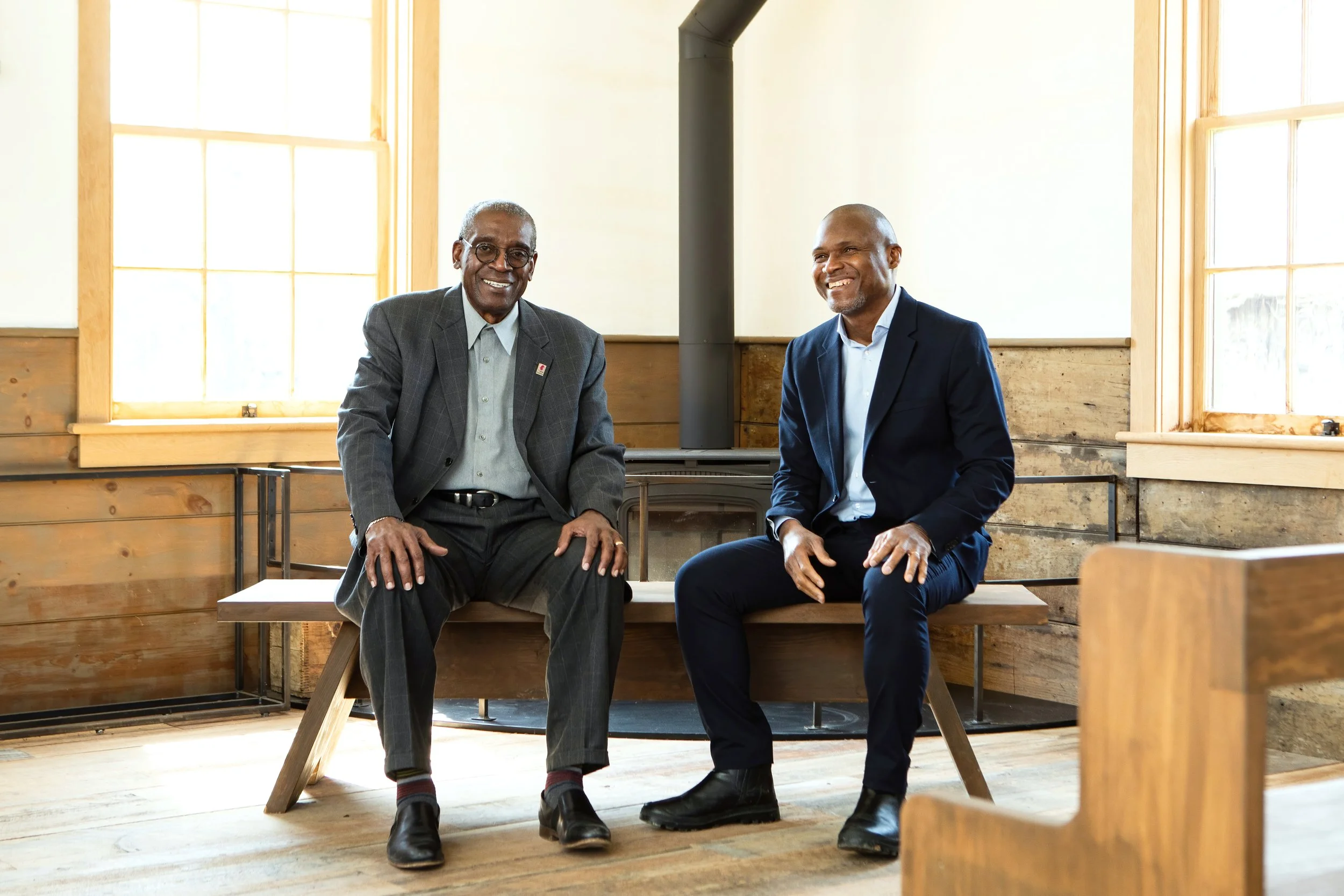
Carl Cadogan (left) and Belonwu Ezenwa (right) inside the African Methodist Episcopal Church
The Church was moved to Fanshawe Pioneer Village in late 2022, and the restoration work was completed in July 2023. “We were given money from different church groups, from the city, the province, and the feds [Federal Government], right down to people who gave $10 or $20 out of their pocket. It was a lot to ask CCLC to manage that money for us and we already ask them to do too much, so London Community Foundation seemed like the right place to be. Everyone was very supportive of making it [moving the Church] happen, and we knew that people would feel good to see there was an entity that they know that was holding the money,” says Carl.
A year after moving the Church, the organization approached London Community Foundation with a proposal to support their transition into London Black Heritage Council. The Foundation granted them a total of $60,000 through our Development granting, and Racial Equity granting programs. The funding allowed them to hire a Youth Intern for the summer of 2024, a full-time Project Co-ordinator, and cover some legal, administrative, and developmental costs.
When Project Co-ordinator Belonwu Ezenwa joined in August 2024, he became the organization’s first-ever employee. In addition to playing a significant role in the organization’s outreach work and administration, a key component of Belonwu’s role is preparing the application to the Canada Revenue Agency (CRA) to obtain charitable status.
“It’s about presenting our objectives to show that they’re reflective of charitable work. We have to show we have the right structures in place to handle funds, and that we’re not taking funds from sources we shouldn’t be,” says Belonwu, a PhD Candidate from Western University’s Faculty of Information and Media Studies. “We need to show we’re a responsible and organized institution, which involves sharing our strategic plan and risk management.”
Gaining charitable status means that London Black Heritage Council will no longer be reliant on the support of other organizations like the CCLC or Fanshawe Pioneer Village to accept grants on their behalf, opening more potential funding streams to them. It will also allow them to issue tax receipts directly to donors who may want to make financial contributions, removing a significant barrier between the organization and potential donors.
As the Council expands its capacity, it hopes to work with other non-profits and funders to learn from their experiences, resources, and best practices to make this growth period as smooth as possible. Belonwu sees the potential room for the Council to expand its programming into many different areas: “We’re looking at a future where we have our arms in practically everything that has anything to do with the Black community,” says Belonwu. “In the next three years we’re looking at having better links with youth and connecting them with businesses – we find there’s a lot of gaps when it comes to youths and business people. We want to improve our programming around the Chapel and harness audiovisual technology to make it more exciting. And we want to work with organizations like the London Public Library to improve access for Black communities in London to the resources and events in the city.”
With the support of partners, including London Community Foundation and our donors and fundholders, the London Black Heritage Council has undergone much change in the last 10 years and reached many milestones. We’re pleased to be able to support the Council and look forward to seeing how they continue to grow their impact in the coming years.